Home Office Wall Art: What to Hang Where You Look and Where You're Seen
A home office has two walls that matter, and you only ever see one of them. The wall you face is yours alone: nobody else looks at it, and you look at it for hours. The wall behind your chair is the opposite. You never see it, but everyone on a video call does. They need different art, and most advice about home office wall art treats them as one.
What should you hang on the wall you face?
This is the wall your eyes land on every time you look up from the screen, so it's doing a job: giving you somewhere to rest them. That favours something small enough not to compete with your work and interesting enough to survive the hundredth glance.
The trap is the motivational poster, which is read once and then becomes furniture. A picture with a joke in it ages better, because there's usually more in it than the first look gives you.
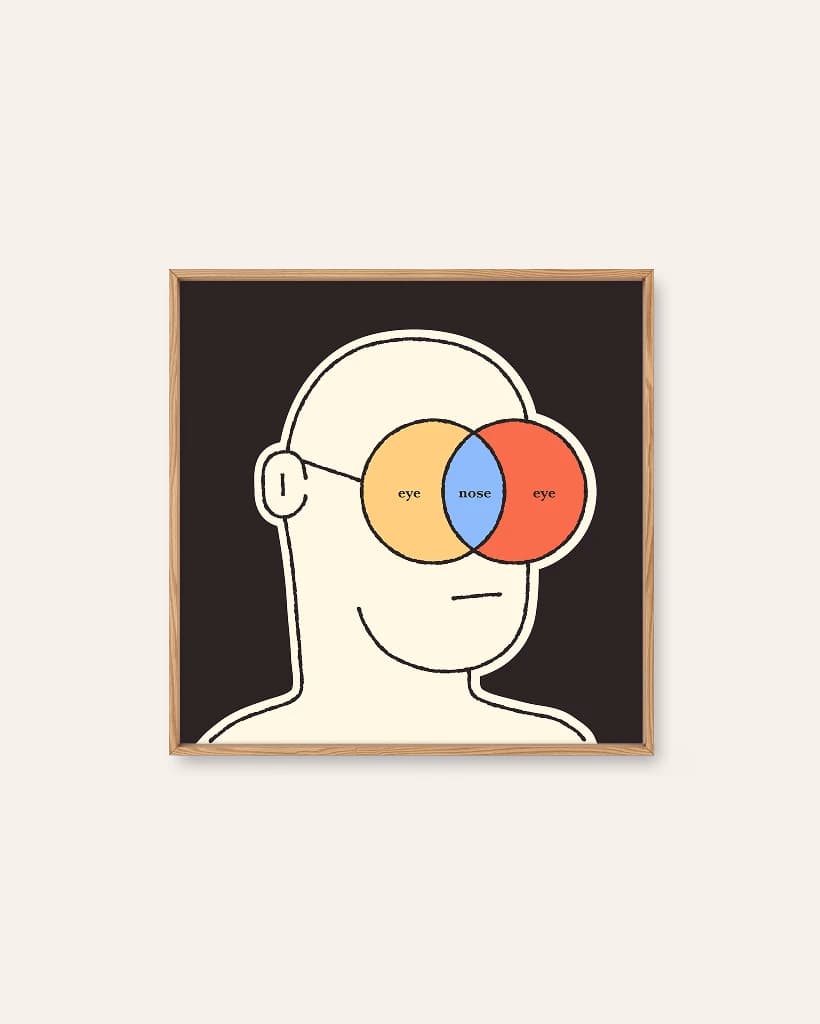
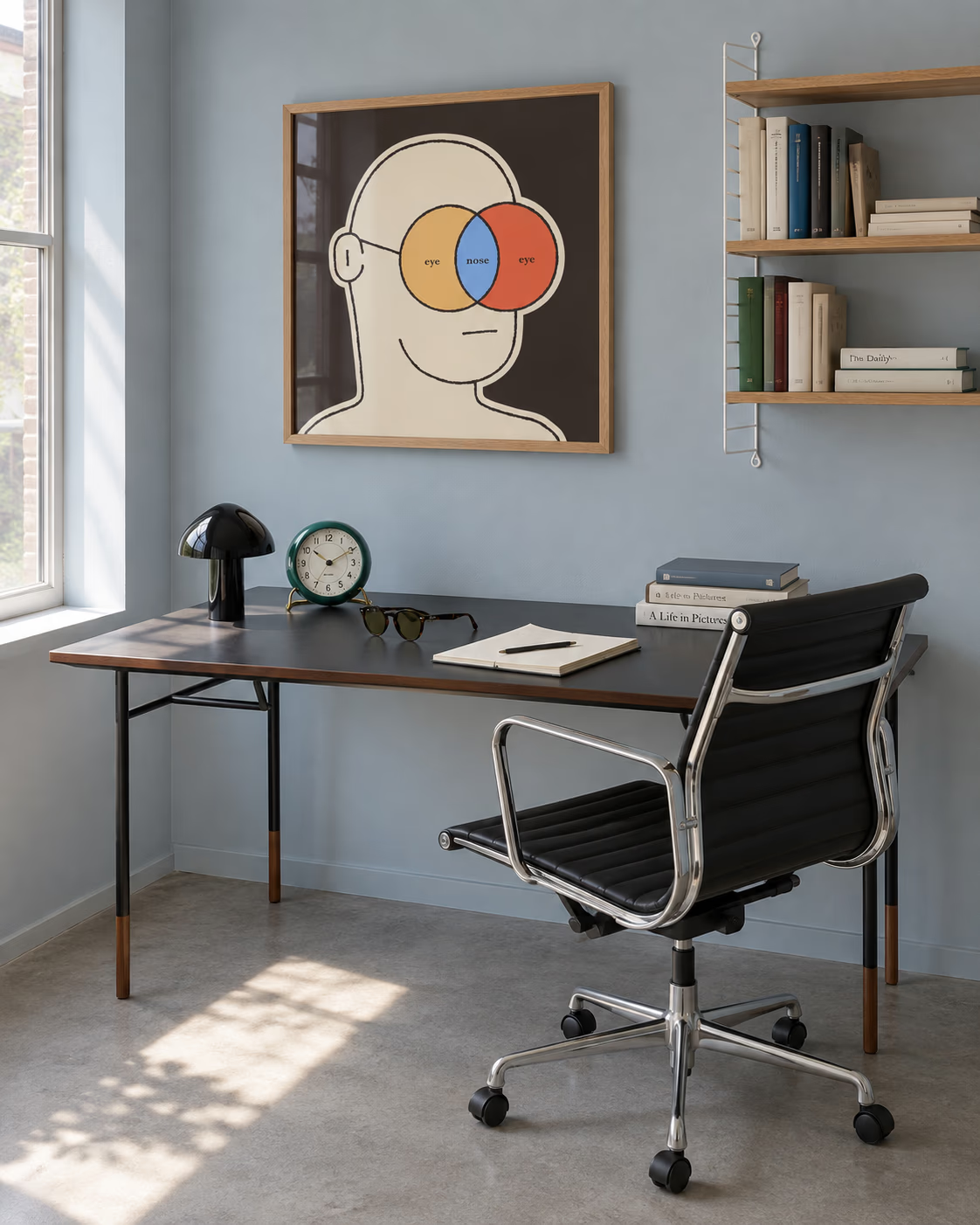
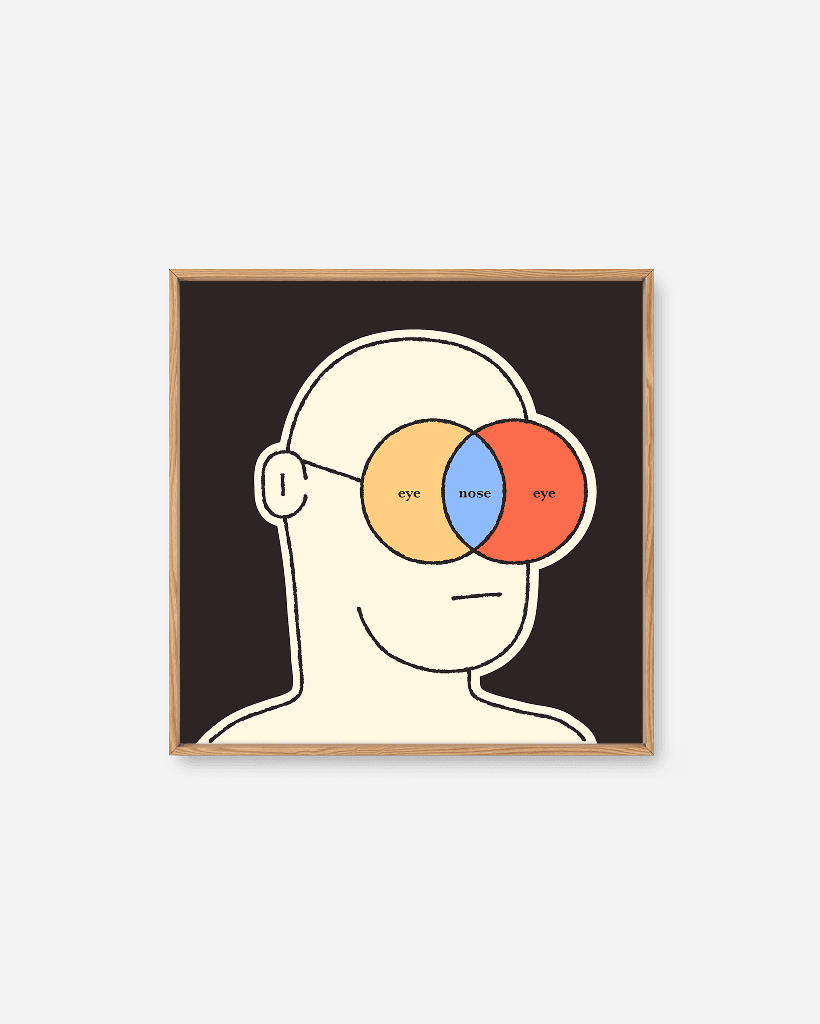
Simen Wahlqvist's Eye Nose Eye is a good test case. It turns a face into a Venn diagram: two overlapping circles labelled eye and eye, and where they meet, nose. The bald head wears the diagram as spectacles, in yellow, red and blue on near black. It's tidy, graphic and quietly ridiculous, and it's a 50 x 50 cm square, which is a forgiving shape beside a monitor. Wahlqvist's own rule, per his bio, is that an illustration is done when it makes him laugh. That's a decent standard for something you'll see every working day.
If you'd rather keep the desk wall quiet, that's a fair choice too. The home office collection leans characterful, but restraint is a legitimate answer: one calm piece, plenty of bare wall around it, and a palette that sits with your desk and screen rather than against them.
What should you hang behind you on a video call?
Here the rules flip. The people on the call see the wall behind you in a few seconds and then mostly ignore it, so it doesn't need to reward study. It needs to read clearly, sit well behind a head and shoulders, and not pull focus from your face.
Your camera also shows less wall than you think, a slice of it around and above your head, so a loose grid can end up cropped to half its pieces. One piece does better than several. Before you drill anything, open your camera preview, sit in your usual position and see what's actually in frame.
Two prints from the gallery make the case for two different kinds of backdrop:
- For a piece with something to find: Mikko Saarainen's URF! is a whole comic page in one print: a knight in blue armour losing an argument with a green dragon, across three panels. It's a 50 x 50 cm square, and it gives anyone on a long call something to puzzle at without you saying a word.
- For a piece that reads at a glance: Simen Wahlqvist's Slingshot is drawn in white on a bright tomato red ground with the fewest lines the joke will allow. A picture that plain reads clearly from a distance, which is exactly the distance a call puts between your colleagues and your wall. Also a 50 x 50 cm square.
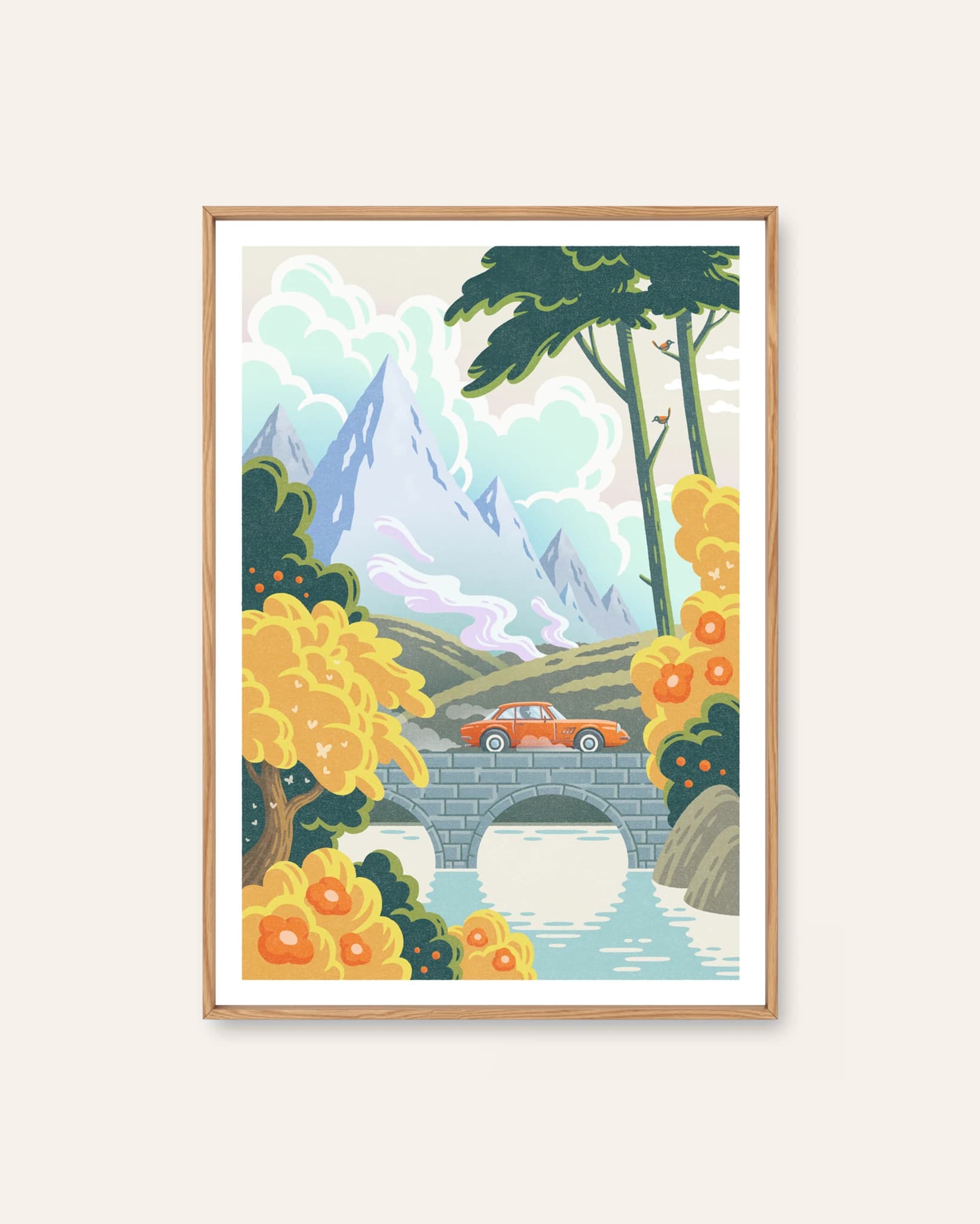
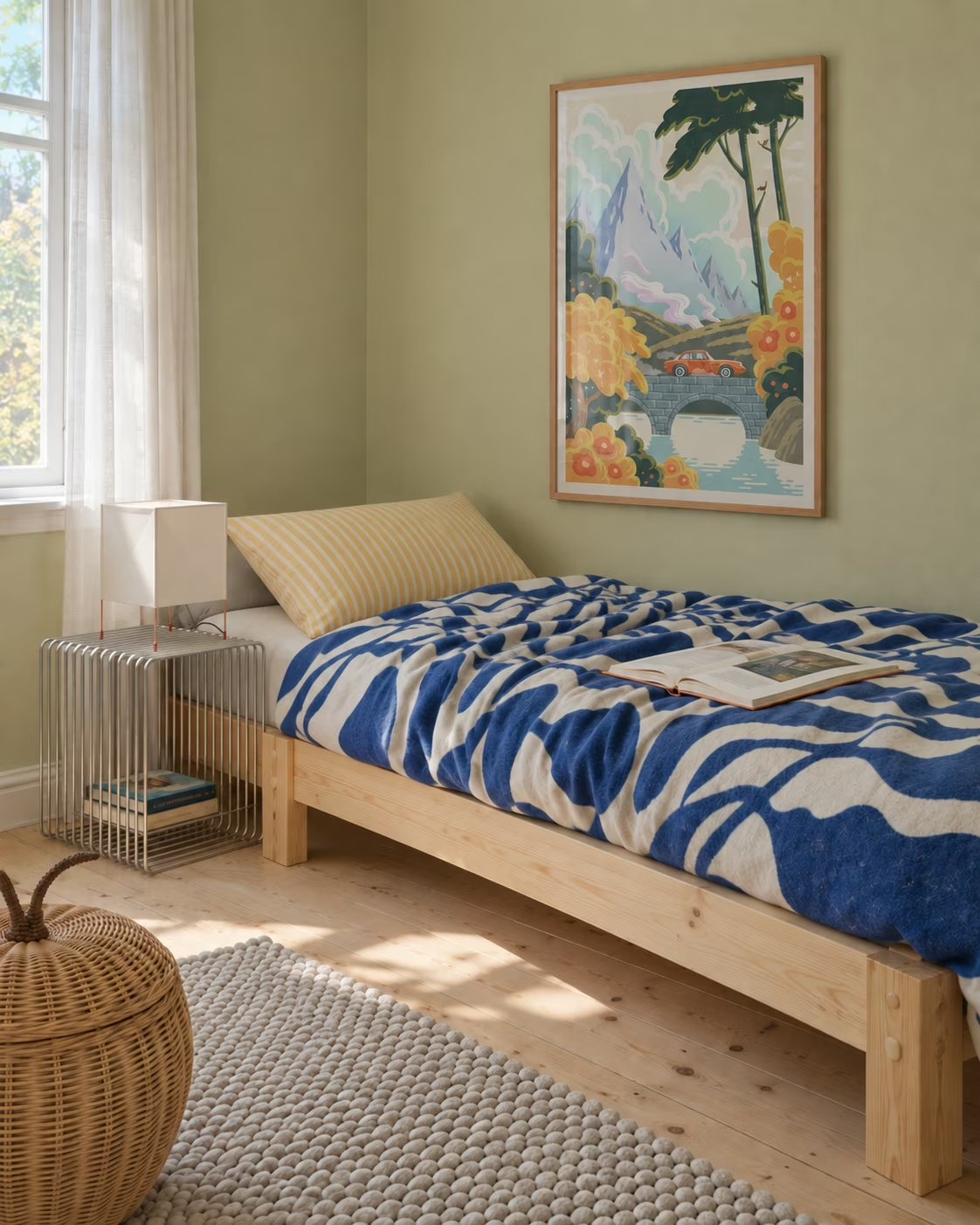
For a calmer backdrop, Mikko Saarainen's Journey takes a red car over a stone bridge below snow-capped mountains, in autumn colours and flat shapes. It's the quietest of his prints, and calm enough to hold a wall on its own. It's a 50 x 70 cm portrait.
How big should art be in a home office?
Size it against what's next to it rather than against the wall. A desk wall is usually a monitor, maybe a shelf, maybe a window, and a print that's much smaller than the screen beside it will look like an afterthought. The 50 x 50 cm squares sit comfortably beside a monitor, and the 50 x 70 cm portraits suit the open wall behind you, where there's nothing to measure against.
The cheapest way to settle it is the tape test: cut paper to the print's size, tape it up, sit down and look. Do it from the desk chair, not from standing height, and do it for a day. The print sizes guide walks through the test and the sizes themselves.
For the desk wall, hang it in your eyeline from the desk, at or just above screen height, as the home office collection suggests. Measure that from the chair. A piece hung at standing eye level is usually too high once you're sitting.
What about glare?
If a print is framed behind glass, the glass will reflect whatever's opposite it, and in a home office that's usually a window or a bright screen. This is a problem you can check for free: sit at the desk, look at the spot where the print will hang, and see what's reflected there at the time of day you work. If a window is throwing light back at you, move the print to a side wall, or look at anti-reflective glazing. The framing guide covers glass versus acrylic.
A print with no glass over it has nothing to throw the light back, which is worth weighing if reflections are the problem on the wall you face.
Where to start
Pick the wall you'd rather solve first. If it's the one behind you, choose a single piece, check it in your camera preview and leave it at that. If it's the one you face, start with a square and live with it for a week before adding anything else. Both are in the home office collection, and the illustrations and abstract pages are good places to keep going.