From picture book to wall: how children's illustrators make prints for adults
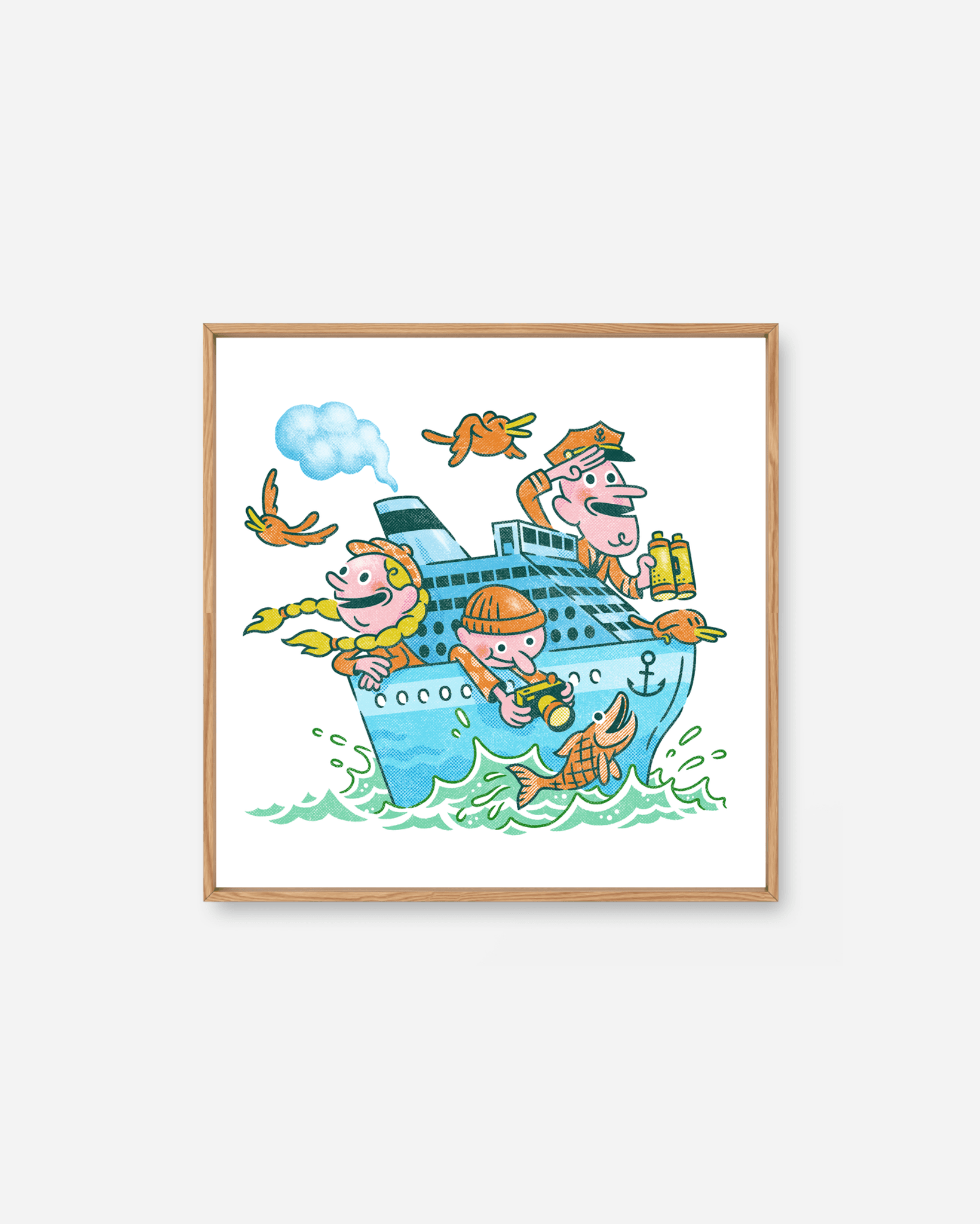
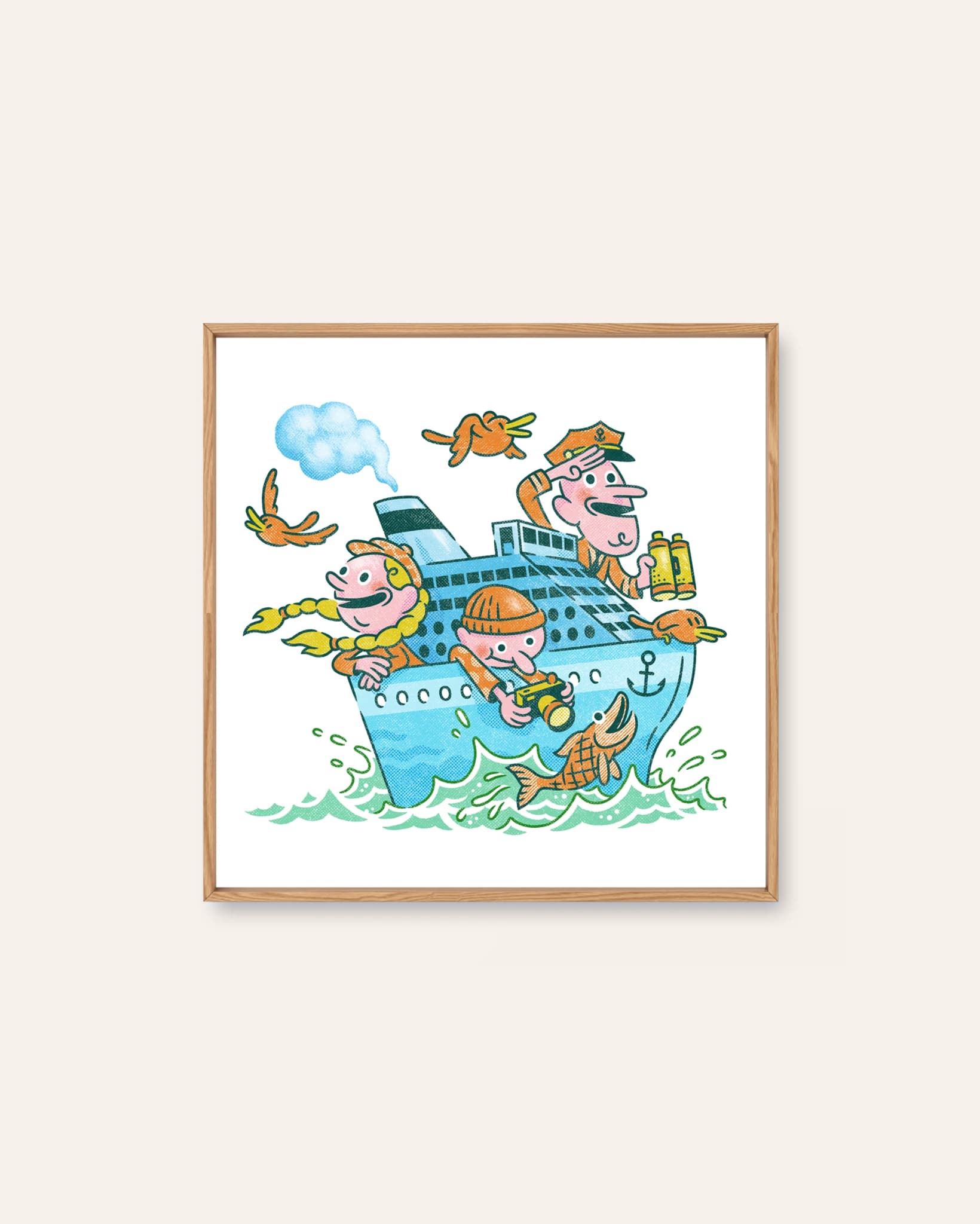
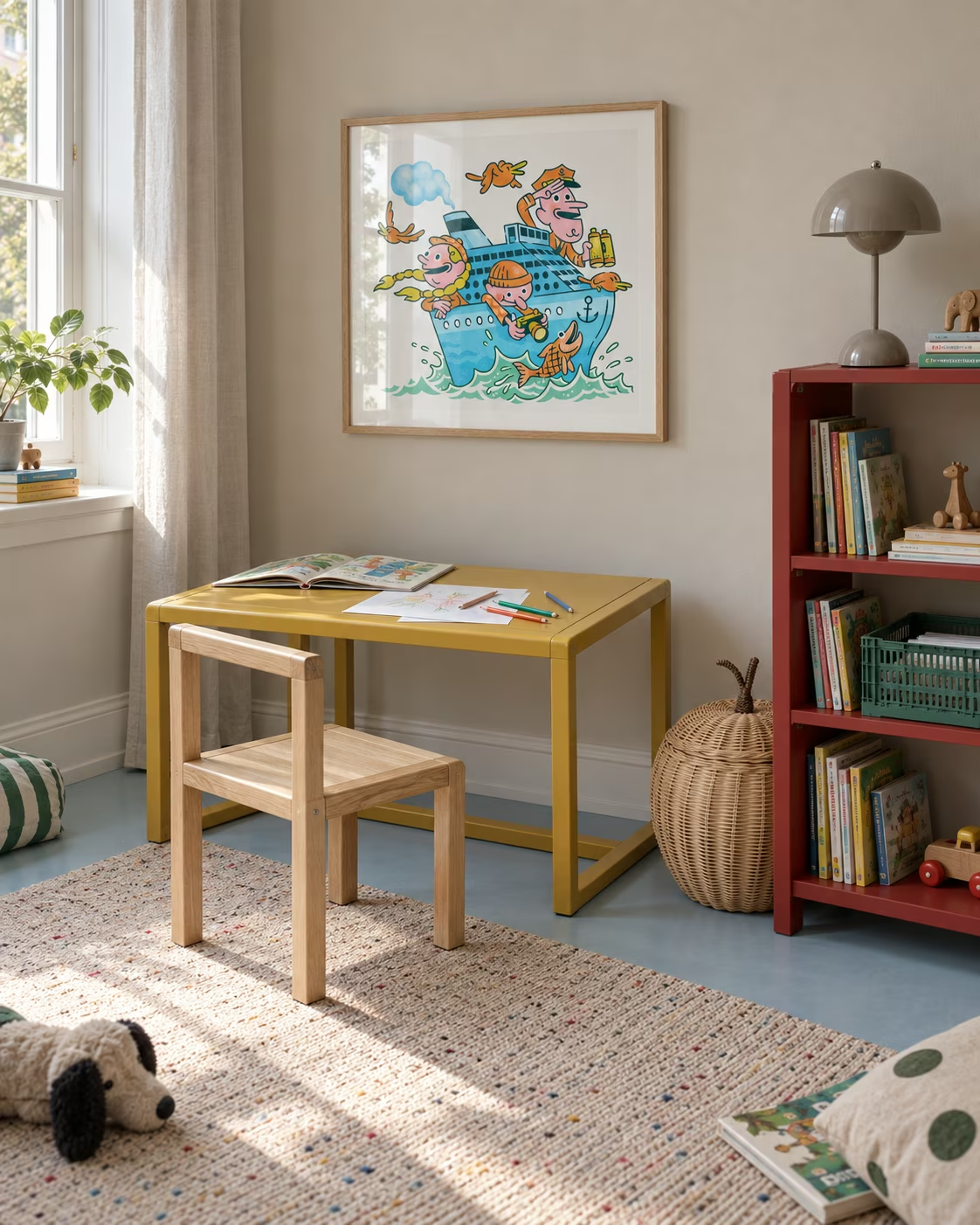
On Mikko Saarainen's Cruise, a captain salutes, a girl's plaits stream out behind her, a boy in a woolly hat aims a yellow camera at the sea and a fish leaps out of the waves. Nobody on the ship is looking at the same thing. Every passenger has spotted something different, and that's the picture.
It's a trick you learn drawing for a page that a child will read slowly, with a finger, and then ask to read again. Three of our artists have spent a good part of their careers doing exactly that, and it shows in what they make for the wall.
Who are the picture-book illustrators in the gallery?
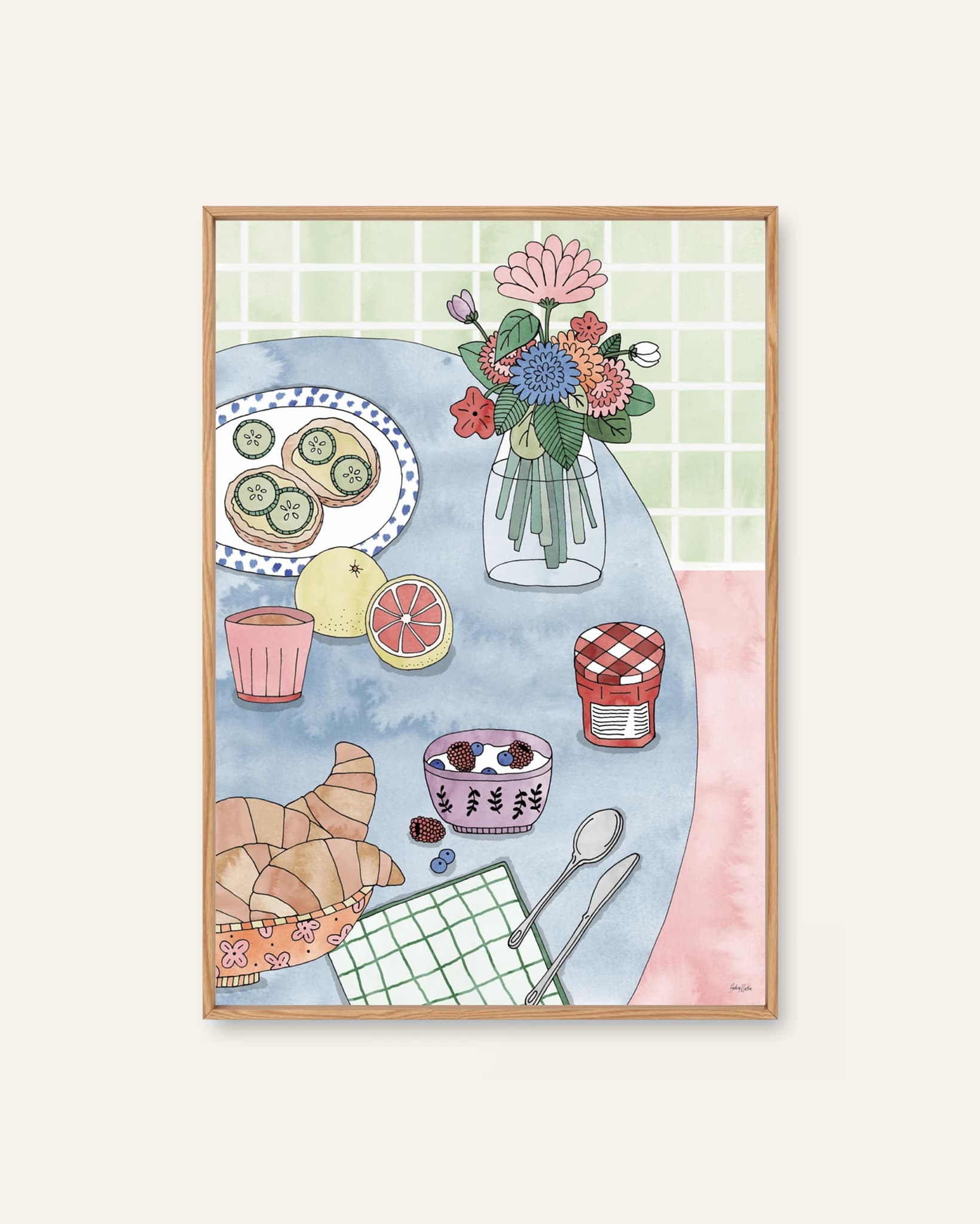
Hedvig Wallin is from Gothenburg and began illustrating children's books at eighteen. She still does, alongside editorial work, murals, logos, labels and posters. Her own site lists children's books among her work, next to poster design, branding and packaging.
Mikko Saarainen lives in Lahti, Finland, and is an illustrator, children's author and comic artist. His publisher Otava lists three of his Barbaari-Ari children's books, from 2025 and 2026, and his agency lists prizes for comics going back to 2009.
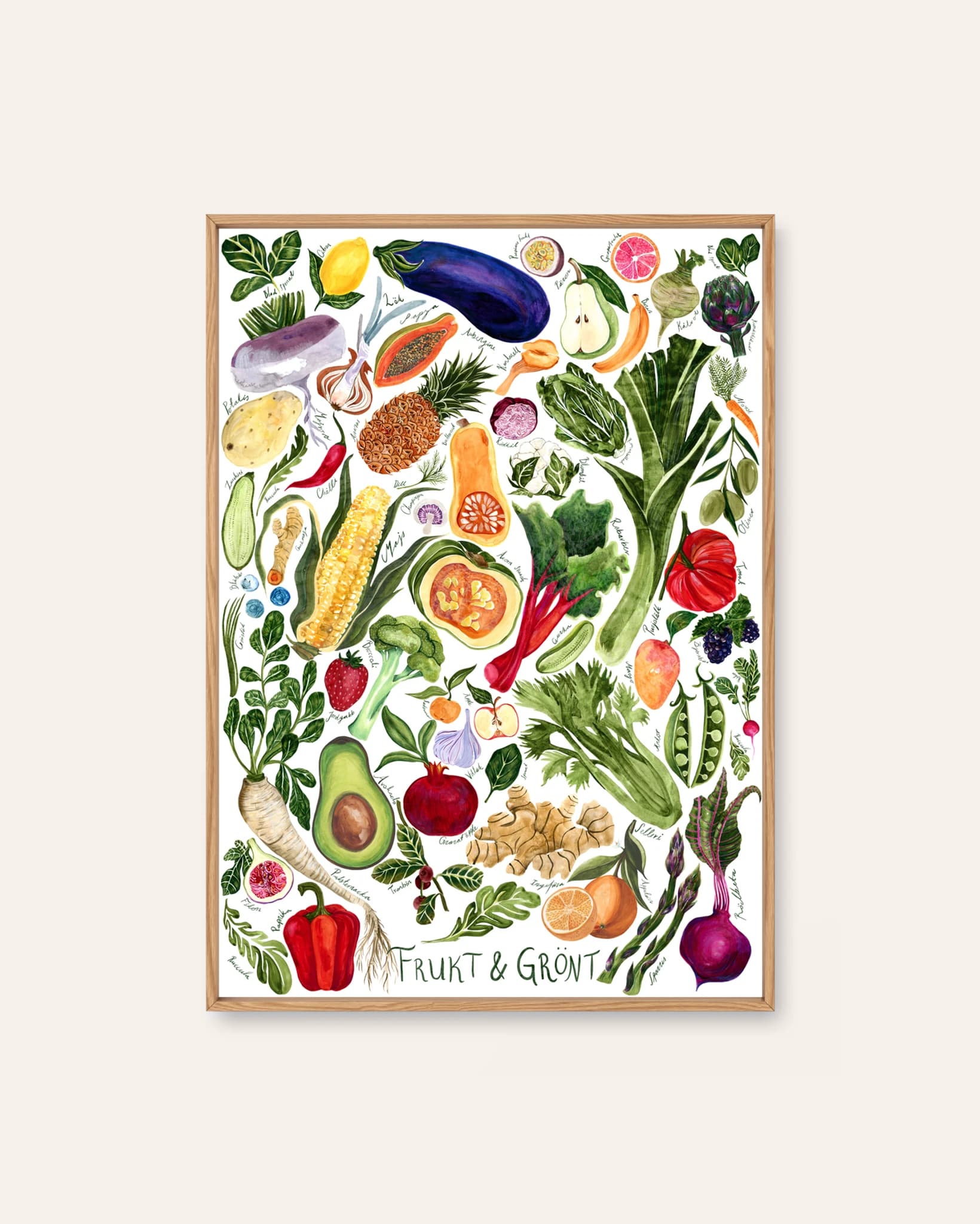
Ishtar Bäcklund Dakhil is a Swedish illustrator with a master's in Visual Communication from Konstfack in Stockholm. Her picture books have been published by Natur och Kultur and Seven Stories Press, and her originals are hand painted in watercolour, natural pigments and mixed media.
They draw very differently from each other. What they share is a way of working that was trained on pages, and the pages are the interesting part.
Detail: a picture that's still giving at the tenth look
A picture book gets read, not glanced at. The illustrator knows the reader will come back, so the drawing has to have somewhere new to send them each time. On a wall, that's a useful property. You see a print every day, and the ones that go quiet after a month are the ones that showed you everything at once.
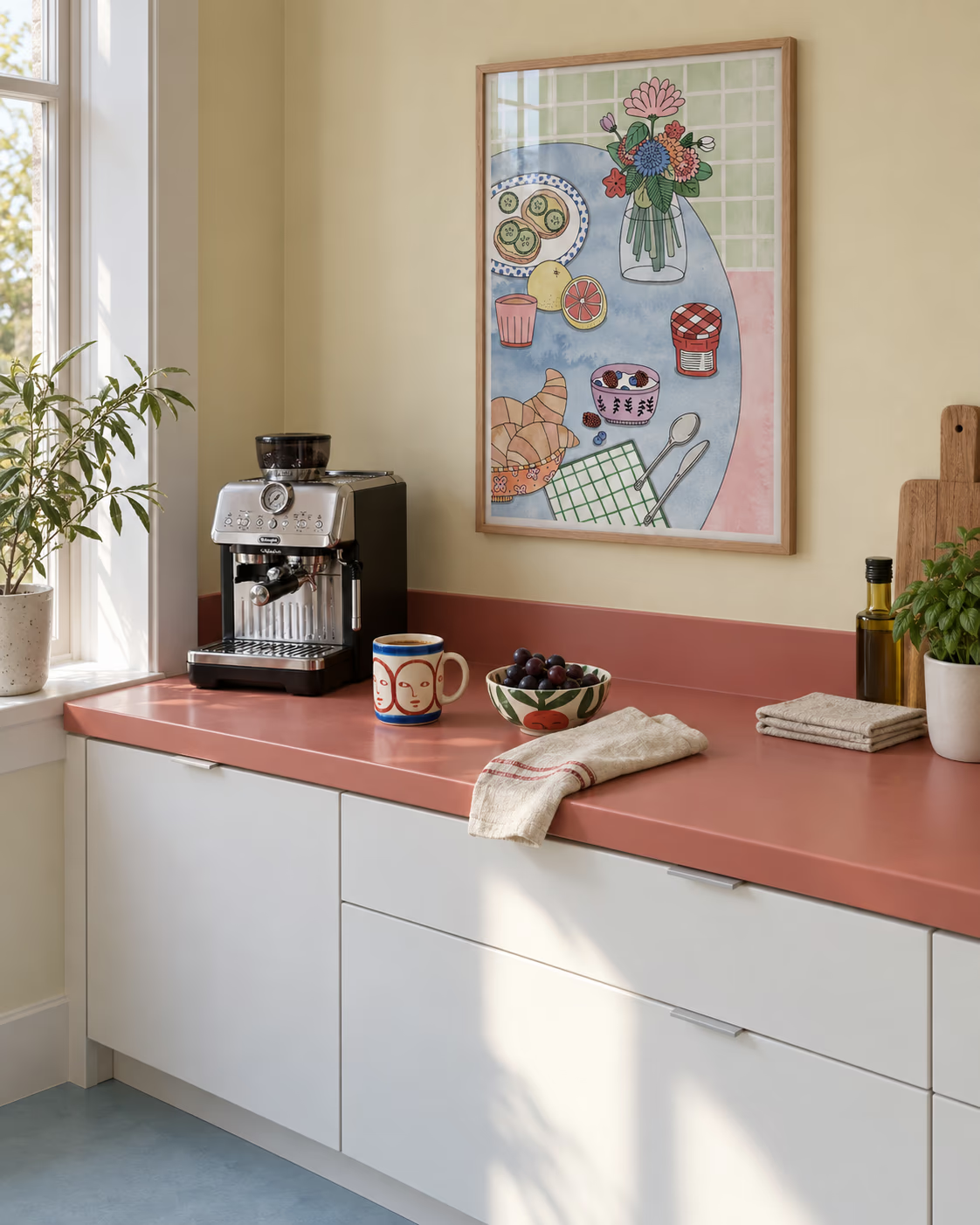
Saarainen keeps his detail going right out to the edges: the Family Trip car is loaded past the roofline, with a mouse on the roof rack, a dog grinning out of one window and a cat hanging out of another. Wallin's Sunday Brunch is a breakfast table seen from above, with croissants, a jar of jam and a halved grapefruit crowding the edges, and a deliberately wonky perspective that makes you hunt. Her Massa Äpplen is a grid of small watercolour apples where no two are alike: pattern from the doorway, a hundred little portraits at arm's length.
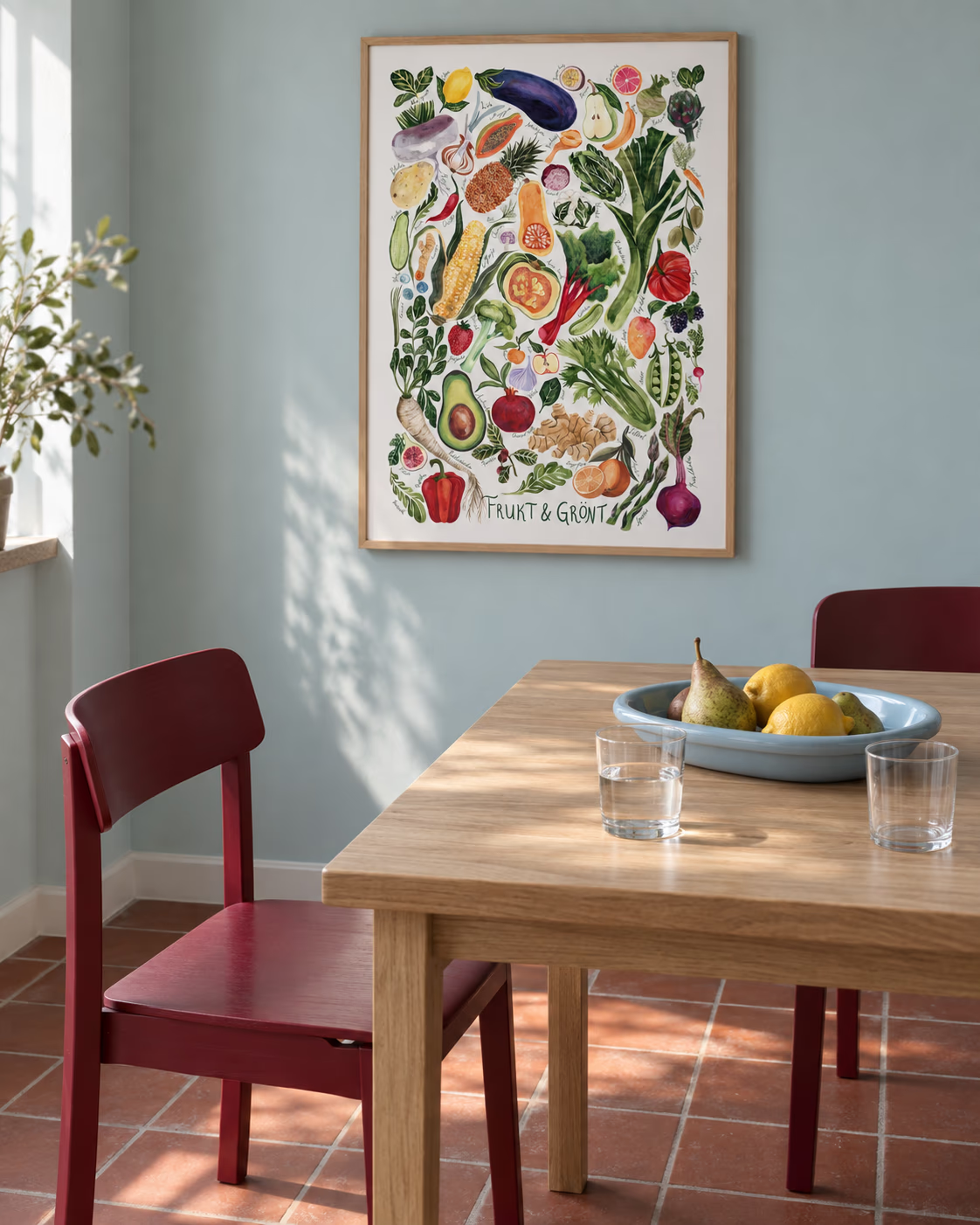
Bäcklund Dakhil's Frukt & Grönt takes the same idea and labels it. Aubergine, pineapple, sweetcorn, tomatoes, each one with a handwritten Swedish name beside it, so the print doubles as a game of finding things.
Narrative: one picture, a whole story
The harder skill in a picture book is telling a story in a single image, because a page turn is a long way off. You can see it in how these prints are built.
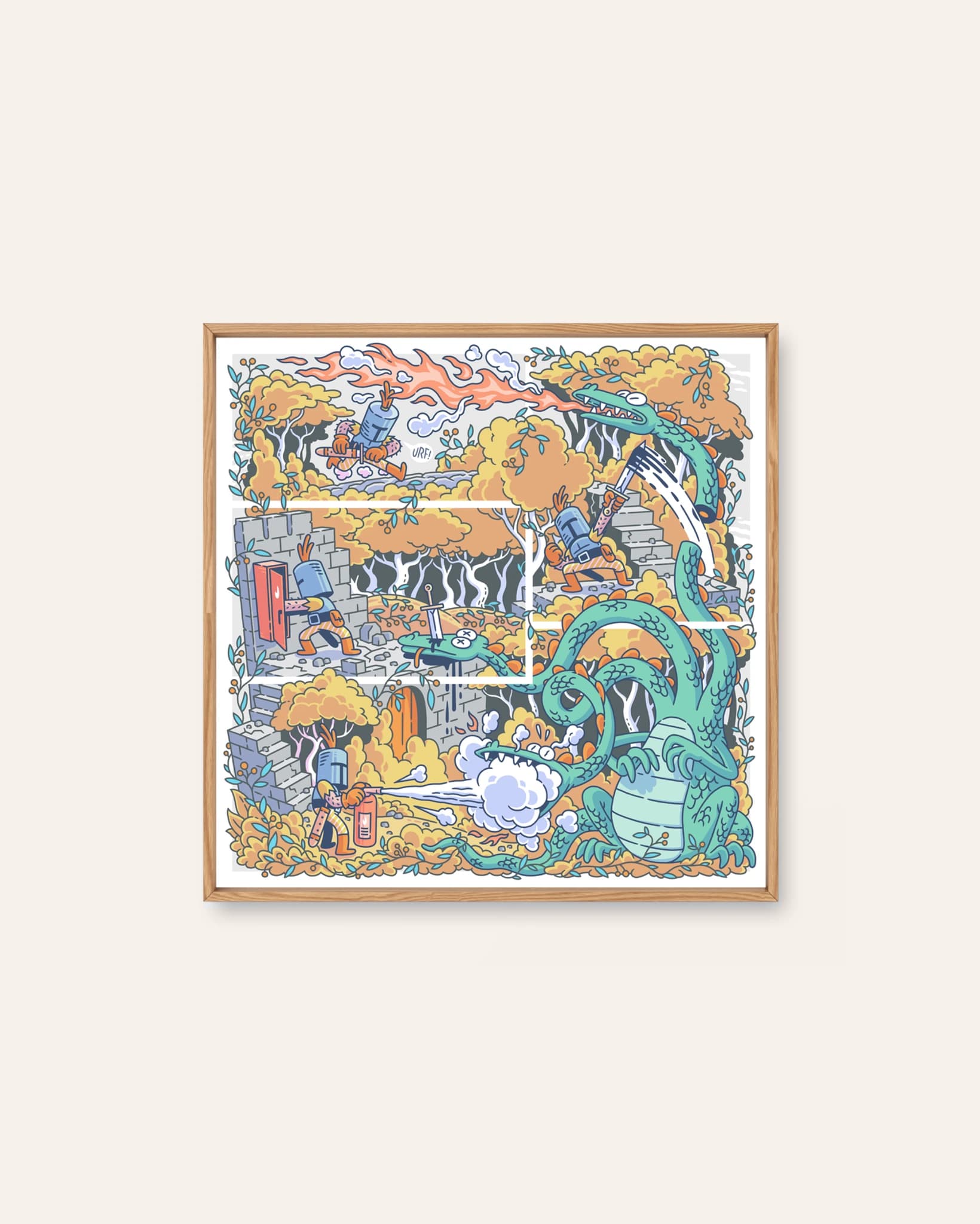
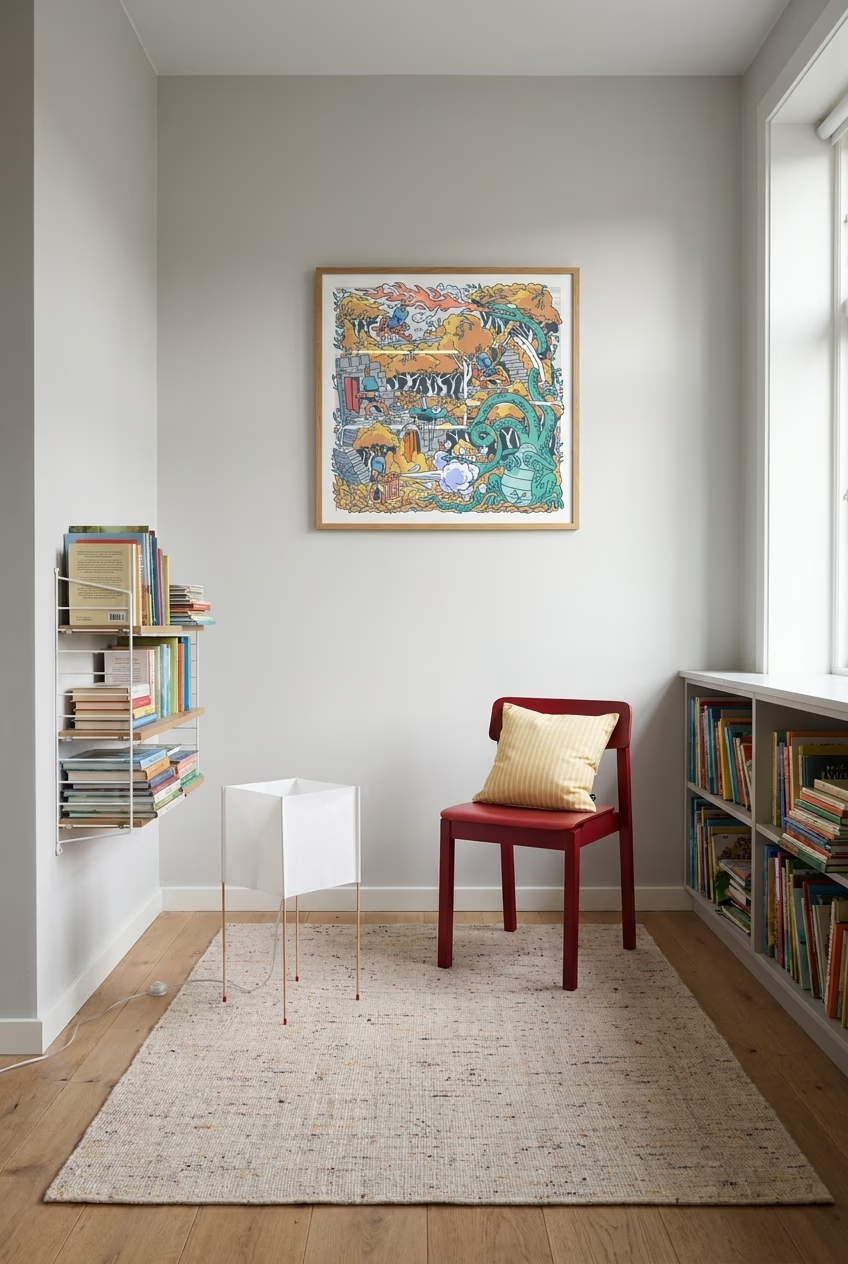
URF! is the clearest case. It's a whole comic page in one print: a knight in blue armour losing an argument with a green dragon across three panels. He's blasted off a wall in the first, swings a sword at the dragon's tail in the second and is down to a fire extinguisher by the third. Elsewhere in the same scene, another knight is creeping through a ruin towards a red door. You can read it left to right in ten seconds or work out the side plot over a week.
Saarainen isn't always loud, either. Journey is the quietest of his prints: a red car on a stone bridge below snow-capped mountains, flat shapes and a muted palette, with the arch of the bridge repeated in its own reflection. It's still a story, only a slower one.
Bäcklund Dakhil's Flight Over the Valley is a spread from her children's book, and it plays with reading: the pale aeroplane across the valley can also be taken as a bird in flight. Her Stockholm does the story of a place instead, with rows of windows, flowering trees and two boats under the rooftops.
Scale: made for a page, working on a wall
A book is held at arm's length. A print is hung where you'll see it from the sofa, the kitchen doorway and the length of a room, so an illustrator used to the page has to make sure the picture still carries when you step back. The good ones do it with a strong shape or a clear colour field, then pay you for coming closer.
That's why the formats matter. Saarainen's Cruise, Family Trip and URF! come as 50 x 50 cm squares, which hold a busy scene without stretching it, and sit well side by side in a run. Journey is 50 x 70 cm, as are Wallin's prints. Bäcklund Dakhil's come in A2, A3, 50 x 50 and 50 x 70 depending on the picture, so check the page for the one you want. The print sizes guide will help you judge what suits your wall.
Can you put children's-book art on an adult's wall?
Yes. A picture drawn for a child can't hide behind being clever or being large. It has to be clear, it has to reward a second look, and it has to be good company. Those are also the things you want from the print beside the kitchen table.
These aren't nursery prints. They're pictures made by people who know how to hold attention, and they're built for a wall you'll look at for years. The history behind that Nordic line, from Kittelsen's trolls to the present day, is in Scandinavian illustrators. And if you're thinking about hanging several together, create an art wall covers how to space them.
Which one to start with?
- If you like to find things: Sunday Brunch or Frukt & Grönt.
- If you like a joke: URF!.
- If you'd like a calm wall with something to find in it: Journey or Small House Big Ocean, Wallin's single house on a rock in a sea of black-ink waves.
The rest of the illustrations are a short browse, and each artist's page shows everything they've made for the gallery.