Nordic botanical prints: folk flowers, a patterned lake and a table full of food
Denmark once spent 122 years cataloguing the wild plants of its kingdom, Norway included. Flora Danica ran from 1761 to 1883 and gathered 3,240 coloured copperplate engravings, one plant to a plate, proposed by the botanist G. C. Oeder so the flora of the Danish crown lands would be on record. Curtis's Botanical Magazine took on the same job in Britain from 1787, and it's still running, past 11,000 plates.
That's the botanical print most of us carry around in our heads, and it's a lovely thing: the specimen dead centre on a plain ground, roots and seed head included, drawn to scale with nothing around it to distract from what it is. It's also a page out of a reference book. It was made to be checked against a real plant.
None of the six botanical prints in this gallery (botaniske trykk, if you're shopping in Norwegian) is doing that job. Two artists, six pictures, not one specimen study among them. Here's what the Nordic version actually looks like.
Folk flowers that were never meant to be identifiable
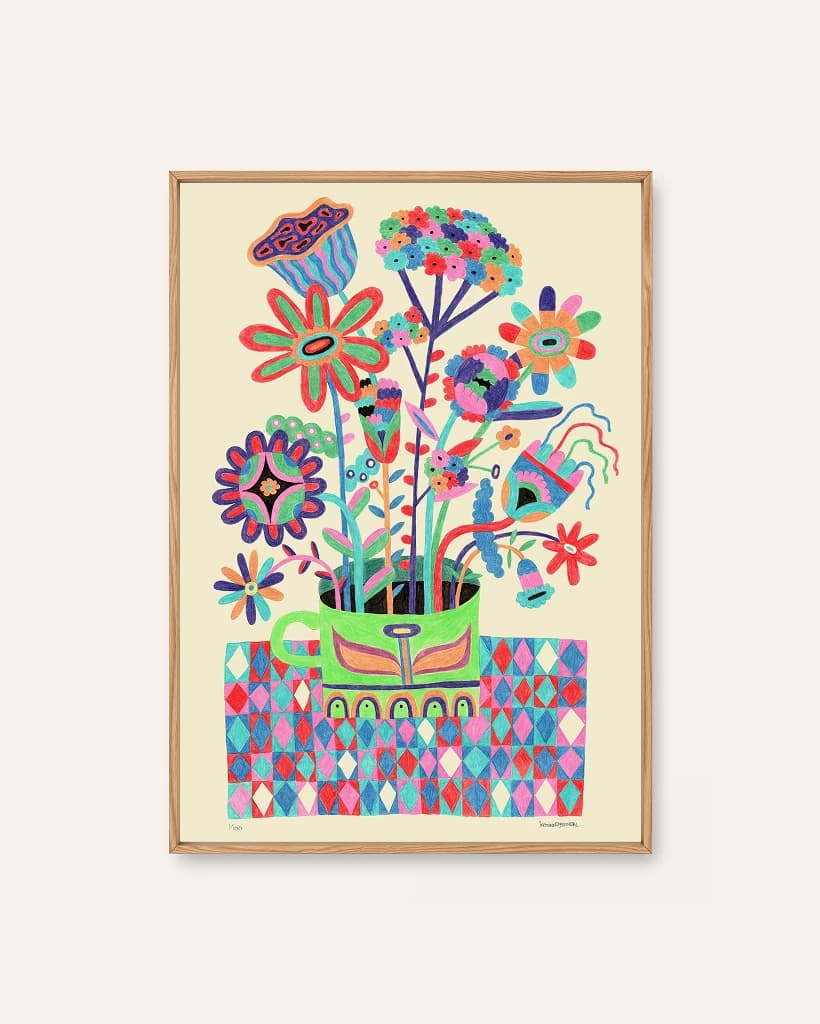
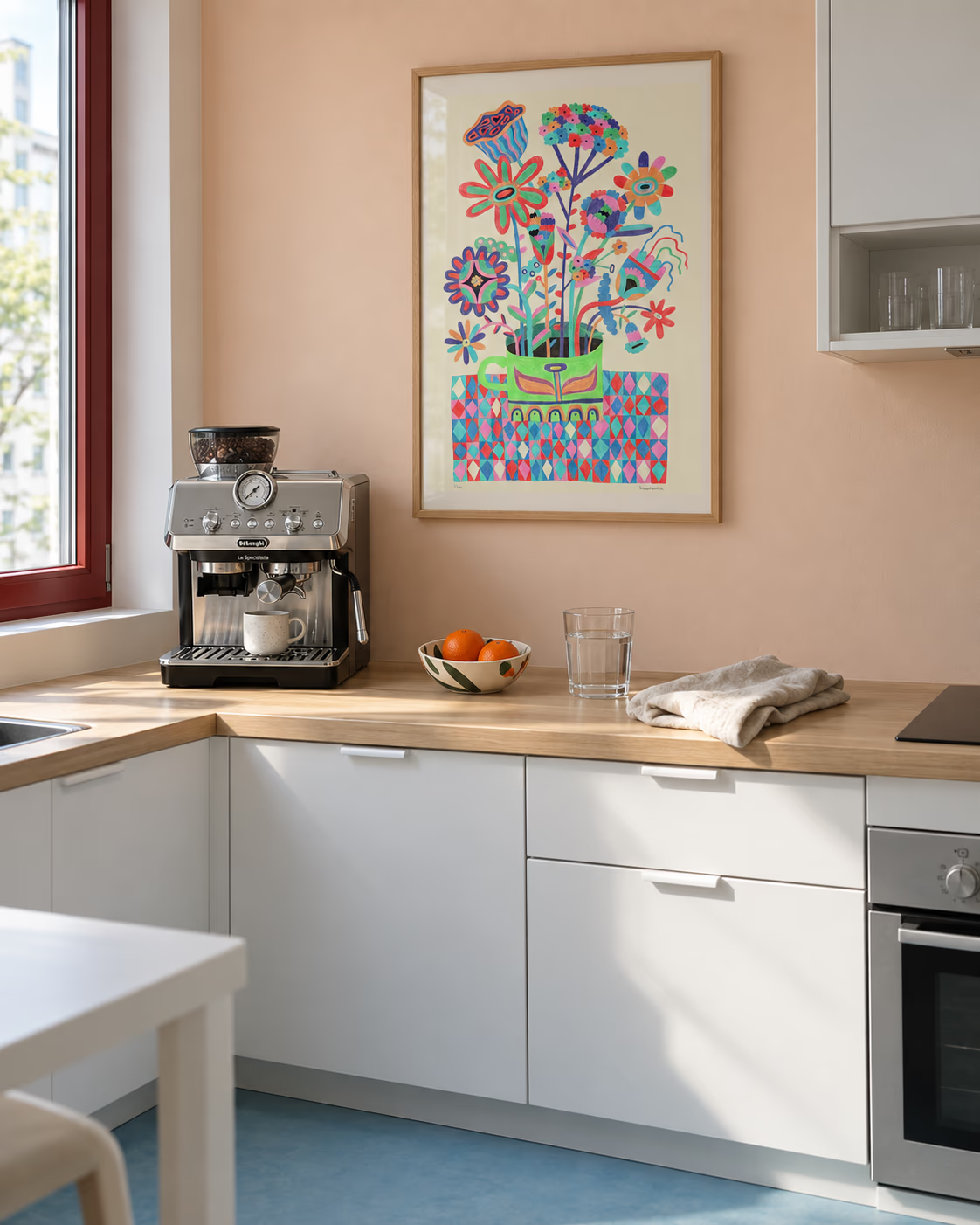
Trysilkaffe by Ingunn Dybendal crams a green mug with an impossible bouquet: folk flowers in red, purple and teal above a diamond-check cloth, every bloom a different invention, drawn petal by petal in coloured pencil. Even the mug carries its own tulip motif. Pattern on pattern on pattern.
There's a long Norwegian precedent for that attitude to a flower. Rosemaling, the decorative painting that flourished from the 1700s to the mid-1800s in valleys such as Hallingdal and Telemark, is built on fantasy flowers: blooms so stylised that no specific flower is identifiable, laid out with scrollwork across ale bowls, cupboards, trunks and church interiors. The aim was ornament, not accuracy.
I couldn't tell you whether Dybendal is thinking about any of that, and I'm not going to put it in her mouth. But it's a useful contrast. Where a botanical plate answers "which plant is this?", Trysilkaffe is answering something closer to "what do flowers do to a room?"
A landscape drawn as pattern
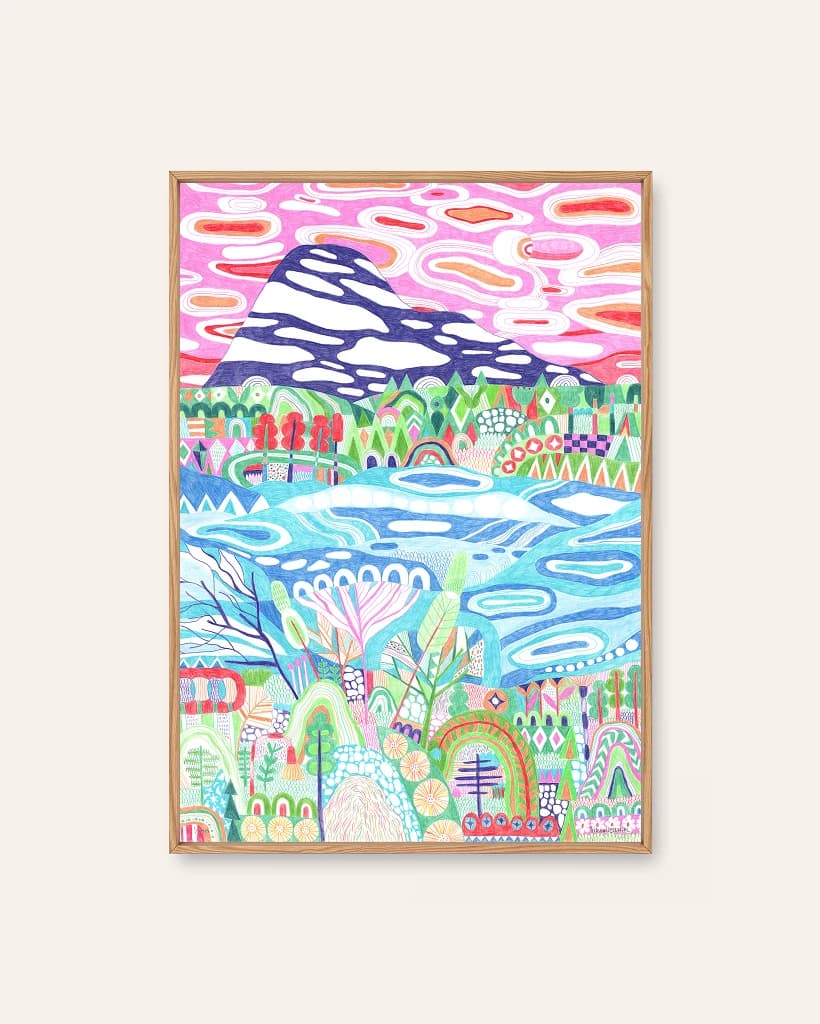
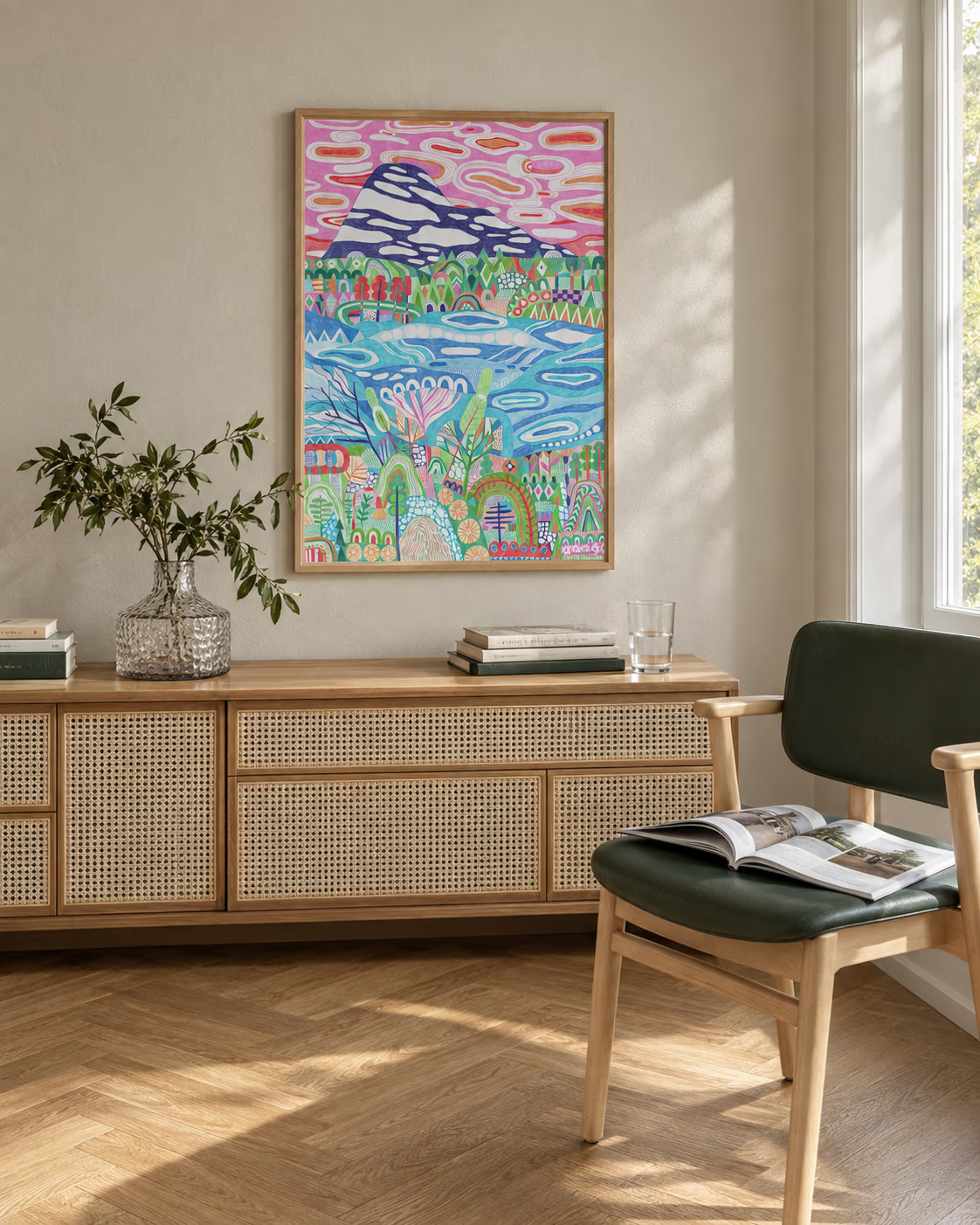
Her second print pushes further. Eltsjoen reimagines a Nordic lake as dense coloured-pencil pattern: pink sky, dark mountain, patterned forest, blue water. Every band of the scene turns into ornament, clouds stretched into ribbons, trees turned into folk motifs, the water pooling in pale rings around a bridge. It's the most detailed piece in the gallery and it rewards the hundredth look as much as the first.
A purist could reasonably ask what it's doing in a botanical category, since there isn't one identifiable plant in it. The plate tradition lifts the plant out of the landscape to study it. Eltsjoen puts the whole landscape back and treats a forest as a texture, which is how a forest actually reads when you're standing in front of one.
The other end of botanical: plants once they're indoors
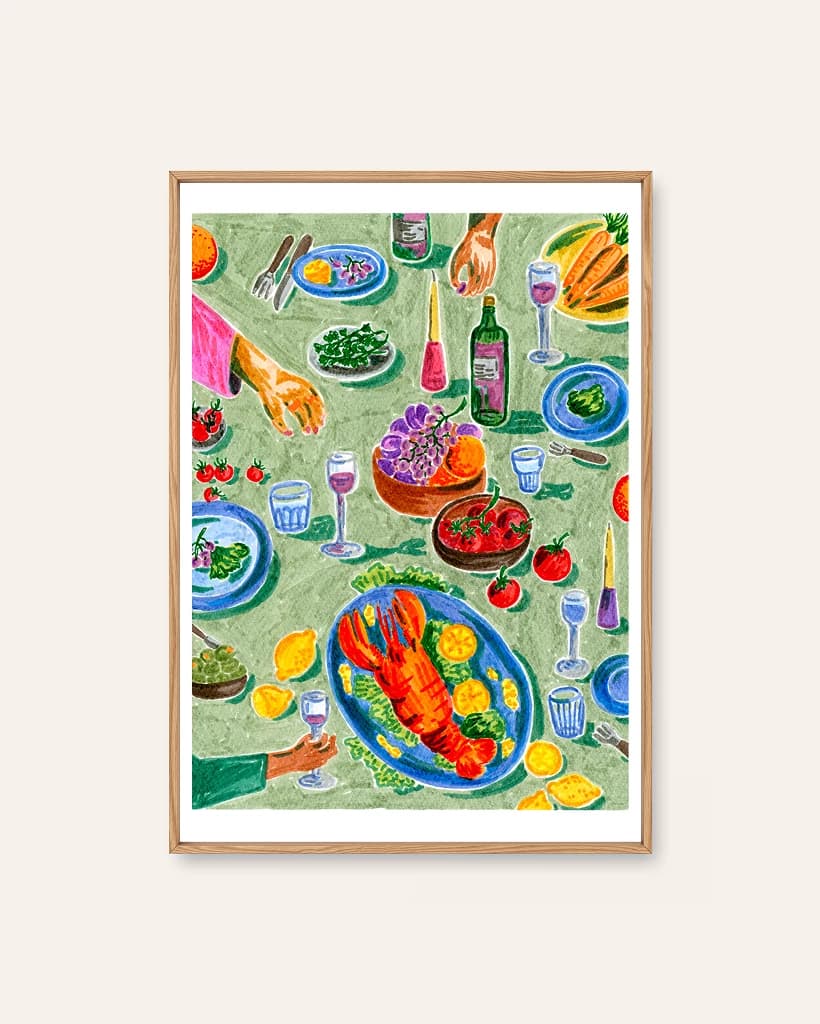
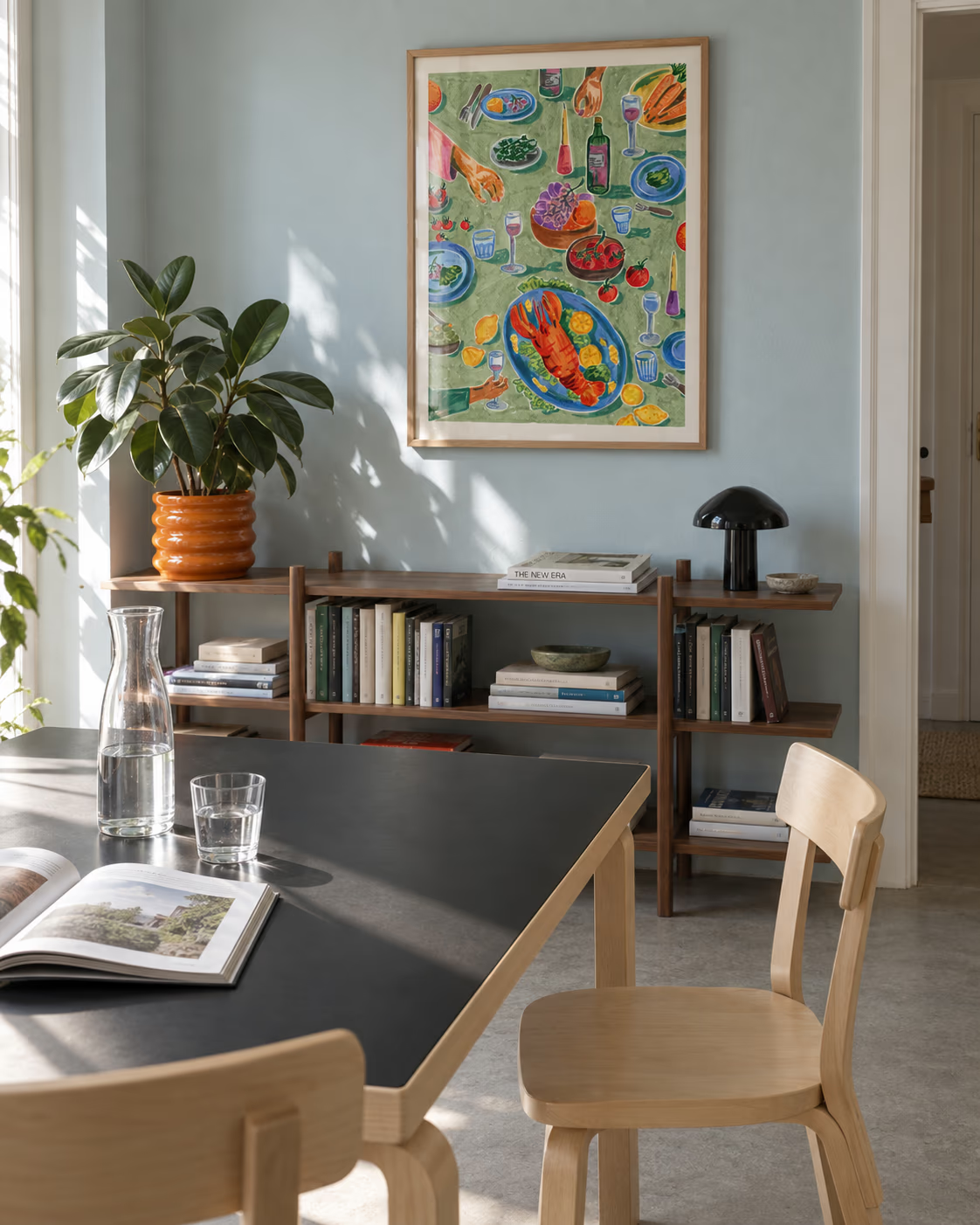
Four of the six are Sia Siamos's table scenes, and they're botanical in the most literal sense going. This is what happens to plants after someone has picked them.
- Hummer og Vin looks straight down on lemons, vine tomatoes, grapes and carrots crowding a green cloth around a lobster, hands reaching in from the edges.
- Hyttefrokost heaps ripe tomatoes and grapes on a striped board against green tiles, with cherry tomatoes scattering across a lilac table.
- Morgenlevering is breakfast in full swing: cafetière coffee, croissants on a checked cloth, pink carnations in a red vase.
- Vinkveld is olives, dark grapes and vine tomatoes in thick, glossy strokes, the cork already adrift.
The titles are plain Norwegian, and the Norwegian words behind the prints takes them one by one if you want the vocabulary.
Fruit and cut flowers have carried still life for centuries, so the subject is old. The handling isn't. Every outline here is quick and confident, closer to a sketchbook page than a formal arrangement, painted loose enough that the scene feels mid-conversation. These aren't drawn to be checked against anything. They're drawn to be recognised, which is a different sort of accuracy.
What the six have in common
Colour first, pattern a close second, and plants treated as part of a life rather than as objects of study. This end of the tradition is folk art rather than science, which is also why it sits so easily in a modern room: it was always meant to be decoration and it's unembarrassed about it.
It hangs better than plates do, too. Botanical plates want a set and a grid, four or six matched in identical frames. These six all print at 50 x 70 cm, so a pair works without any of that formality, and the pairing becomes a choice about temperament rather than taxonomy. A Dybendal beside a Siamos is pattern next to appetite.
If that's the corner of the gallery you want, start with the botanical prints and let the rest of the Scandinavian wall art wait its turn. For the wider background, what is Scandinavian art covers the sensibility all twenty prints share.